
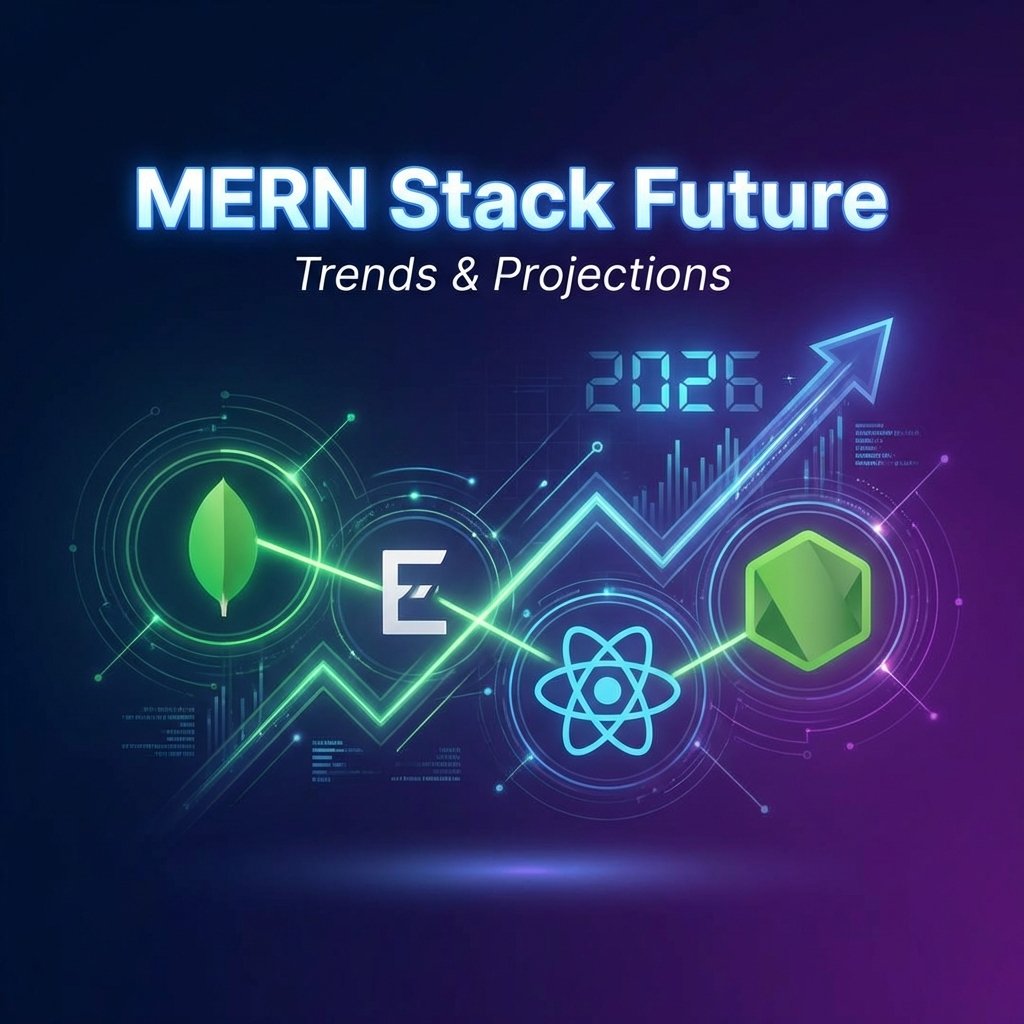
The MERN Stack: A Dominant Force in 2026
Despite the rise of new frameworks like Svelte or Qwik, the MERN Stack (MongoDB, Express.js, React, Node.js) remains the undisputed king of full-stack development in India and globally.
Why MERN Won’t Die Anytime Soon
- React’s Massive Ecosystem: React isn’t just a library; it’s a standard. With React Server Components (RSC) and Next.js, it has evolved to handle SEO and performance better than ever.
- Unified JavaScript Language: Using JS for both Client and Server reduces context switching and training costs for companies.
- Startup Favorite: For MVPs (Minimum Viable Products), MERN allows rapid development and scalability.
MERN vs The Rest (2026 Comparison)
| Factor | MERN Stack | Java Full Stack | Python (Django/FastAPI) |
|---|---|---|---|
| Learning Curve | Moderate | Steep | Easy to Moderate |
| Performance | High (V8 Engine) | Very High | Moderate |
| Job Openings | Highest (Startups & MNCs) | High (Enterprises) | High (AI/Data focused) |
MERN vs MEAN vs MEVN: Which Stack Wins in 2026?
While MERN dominates, it’s important to understand how it compares to its close cousins:
MERN Stack (MongoDB, Express, React, Node.js)
- Market Share: 65% of JavaScript full stack jobs
- Strengths: React’s massive ecosystem, component reusability, virtual DOM performance
- Best For: SPAs, real-time apps, modern web applications
- Job Demand: Highest among all JavaScript stacks
MEAN Stack (MongoDB, Express, Angular, Node.js)
- Market Share: 25% of JavaScript full stack jobs
- Strengths: TypeScript by default, enterprise-grade, opinionated structure
- Best For: Large enterprise applications, complex business logic
- Job Demand: Strong in enterprise and banking sectors
MEVN Stack (MongoDB, Express, Vue.js, Node.js)
- Market Share: 10% of JavaScript full stack jobs
- Strengths: Gentle learning curve, lightweight, progressive framework
- Best For: Small to medium projects, rapid prototyping
- Job Demand: Growing but still niche
Verdict for 2026: MERN Stack wins for job opportunities, community support, and ecosystem maturity.
Real-World MERN Projects Powering India’s Tech Ecosystem
Understanding how major companies use MERN helps you appreciate its real-world value:
Swiggy (Food Delivery)
- Tech Stack: React (frontend), Node.js (backend), MongoDB (database)
- Scale: 50+ million users, 200,000+ restaurants
- Key Features: Real-time order tracking, dynamic pricing, recommendation engine
- Why MERN: Real-time updates, scalable architecture, fast development cycles
Ola (Ride Sharing)
- Tech Stack: React Native (mobile), Node.js (backend), MongoDB (geospatial data)
- Scale: 250+ million users across India
- Key Features: Live location tracking, surge pricing, driver matching
- Why MERN: Real-time capabilities, JSON-based data, horizontal scalability
Urban Company (Home Services)
- Tech Stack: React (web), Node.js (microservices), MongoDB (user data)
- Scale: 10+ million customers, 50,000+ service professionals
- Key Features: Booking system, payment processing, professional matching
- Why MERN: Rapid feature development, unified JavaScript, cost-effective
CRED (Fintech)
- Tech Stack: React (frontend), Node.js (API gateway), MongoDB (user profiles)
- Scale: 10+ million credit card users
- Key Features: Credit score tracking, rewards system, bill payments
- Why MERN: Fast iterations, modern UI, seamless integrations
Complete MERN Learning Roadmap 2026
A structured 6-month plan to become job-ready as a MERN Stack developer:
Month 1-2: Frontend Fundamentals
- Week 1-2: HTML5, CSS3, Flexbox, Grid
- Week 3-4: JavaScript ES6+, DOM manipulation, async programming
- Week 5-6: Git, GitHub, command line basics
- Week 7-8: Responsive design, Bootstrap/Tailwind CSS
- Project: Build a portfolio website
Month 3: React.js Deep Dive
- Week 1: Components, props, state, lifecycle methods
- Week 2: Hooks (useState, useEffect, useContext, custom hooks)
- Week 3: React Router, form handling, API integration
- Week 4: State management (Context API, Redux Toolkit)
- Project: Build a movie search app using TMDB API
Month 4: Backend with Node.js & Express
- Week 1: Node.js fundamentals, npm, modules
- Week 2: Express.js, routing, middleware, error handling
- Week 3: RESTful API design, authentication (JWT)
- Week 4: File uploads, email integration, security best practices
- Project: Build a blog API with authentication
Month 5: MongoDB & Database Design
- Week 1: MongoDB basics, CRUD operations, Mongoose ODM
- Week 2: Schema design, relationships, indexing
- Week 3: Aggregation pipeline, performance optimization
- Week 4: Database security, backup strategies
- Project: Build a task management API with MongoDB
Month 6: Full Stack Integration & Deployment
- Week 1: Connect React frontend with Node.js backend
- Week 2: State management across full stack, error handling
- Week 3: Deployment (Vercel for frontend, Render/Railway for backend)
- Week 4: Testing (Jest, React Testing Library), CI/CD basics
- Final Project: Build a full-stack e-commerce application
Bonus Skills for 2026:
- TypeScript (mandatory for professional development)
- Next.js (for SEO and server-side rendering)
- GraphQL (alternative to REST APIs)
- Docker (containerization)
- AWS/Azure basics (cloud deployment)
MERN Developer Salary Expectations in India
Understanding salary ranges helps you negotiate better and plan your career:
Fresher MERN Developer (0-1 Year)
- Service Companies: 3.5-5.5 LPA
- Product Companies: 6-10 LPA
- Startups: 4-8 LPA + Equity
- Average: 5.5 LPA
Junior MERN Developer (1-3 Years)
- Service Companies: 5-9 LPA
- Product Companies: 10-18 LPA
- Startups: 8-15 LPA + Equity
- Average: 10 LPA
Mid-Level MERN Developer (3-5 Years)
- Service Companies: 9-15 LPA
- Product Companies: 18-30 LPA
- Startups: 15-25 LPA + Equity
- Average: 18 LPA
Senior MERN Developer (5-8 Years)
- Service Companies: 15-25 LPA
- Product Companies: 30-50 LPA
- Startups: 25-40 LPA + Significant Equity
- Average: 28 LPA
MERN Architect / Tech Lead (8+ Years)
- Service Companies: 25-40 LPA
- Product Companies: 50-80 LPA
- Startups: 40-60 LPA + Equity/ESOPs
- Average: 45 LPA
Salary Boosters:
- TypeScript proficiency: +15-20%
- AWS/Azure certifications: +20-25%
- System design skills: +25-30%
- Open source contributions: +10-15%
Top 20 Companies Hiring MERN Developers in 2026
Product-Based Companies (Premium Salaries)
- Flipkart - 12-45 LPA
- Swiggy - 10-40 LPA
- Zomato - 9-38 LPA
- CRED - 18-55 LPA
- PhonePe - 15-50 LPA
- Razorpay - 12-42 LPA
- Meesho - 10-35 LPA
- ShareChat - 12-40 LPA
- Dream11 - 15-45 LPA
- Paytm - 10-38 LPA
Service-Based Companies (Volume Hiring)
- TCS - 3.5-18 LPA
- Infosys - 4-20 LPA
- Wipro - 3.8-19 LPA
- Cognizant - 4.2-22 LPA
- HCL Technologies - 3.6-18 LPA
High-Growth Startups
- Zepto - 12-35 LPA
- Licious - 10-30 LPA
- Groww - 15-40 LPA
- Jupiter - 12-35 LPA
- Slice - 10-32 LPA
Common MERN Interview Questions 2026
Prepare for these frequently asked questions to ace your interviews:
Technical Questions
- Explain the virtual DOM and how React uses it for performance.
- What are React Hooks? Explain useState, useEffect, and useContext with examples.
- How does Node.js handle asynchronous operations? Explain the event loop.
- What is middleware in Express.js? Give examples of custom middleware.
- Explain indexing in MongoDB and when to use it.
- What is the difference between SQL and NoSQL databases?
- How do you handle authentication in a MERN application?
- Explain CORS and how to handle it in Express.js.
- What are the differences between REST and GraphQL?
- How do you optimize React application performance?
System Design Scenarios
- Design a URL shortener (like bit.ly)
- Design a real-time chat application
- Design a food delivery system (like Swiggy)
- Design a social media feed
- Design a booking system
Coding Challenges
- Implement debouncing and throttling in React
- Build a custom hook for API calls
- Create a pagination component
- Implement infinite scrolling
- Build a form with validation
Interview Preparation Tips:
- Practice on LeetCode for DSA
- Build 3-5 full-stack projects for your portfolio
- Contribute to open source MERN projects on GitHub
- Mock interviews with peers
- Study system design fundamentals
Key Trends for MERN Developers in 2026
- TypeScript is Mandatory: Plain JS is fading. TypeScript usage in MERN projects is now the industry standard. Learn more at TypeScript Official Docs.
- Serverless MERN: Deploying Node/Express apps on AWS Lambda or Vercel Edge functions. Check out Vercel’s Documentation for deployment guides.
- AI Integration: Building UI components that interact with LLM APIs (OpenAI, Gemini). Explore OpenAI’s API Documentation to get started.
Frequently Asked Questions
Q: Is MERN Stack still relevant in 2026?
A: Yes! MERN Stack remains highly relevant with React’s massive ecosystem, unified JavaScript language, and strong demand from startups and enterprises.
Q: Should I learn MERN Stack or Java Full Stack?
A: Both are valuable. MERN has a moderate learning curve and is preferred by startups, while Java Full Stack is favored by large enterprises. Choose based on your career goals.
Q: Is TypeScript necessary for MERN Stack development?
A: In 2026, TypeScript is considered mandatory for professional MERN development. It provides type safety and better developer experience.
Conclusion
If you are wondering whether to start learning MERN in 2026: The answer is a resounding YES. It remains the most versatile skill set for getting hired quickly. The ecosystem continues to evolve with modern features like React Server Components and serverless deployment options.
Start Learning Today:
Enroll in our MERN Stack Certification Course and build 5+ live projects.


Comments
Leave a Comment
Your comment will appear after moderation (usually within 24 hours).